
In this blog i am going to discuss about the team concept, positive and negative group roles, problem solving, virtual team, stages in the life of a group and last the symptoms of group thinking.
What do you mean by “THE TEAM CONCEPT”?
It means to understand the behavior of group members and ability to tap the constructive power of a team.
POSITIVE & NEGATIVE GROUP MEMBER ROLES:
•Individuals and what they choose to do
•Example and direction of leaders
•Modeling and reinforcing positive versus negative group member roles
Roles that build performance are:
•Encourager: Helps people make contributions to fulfill their potential
•Clarifier: Creates order out of chaos and replaces confusion with clarity
•Harmonizer: Brings together opposite points of view
•Idea generator: Suggests ideas that others do not
•Ignition key: Orchestrates and facilitates the group’s work
•Standard setter: Possesses knowledge and skills deemed important by the group
•Detail specialist: Searches for errors and omissions and keeps the group on red alert
Roles that reduce the performance:
•Ego tripper: Interrupts others, launches into long monologues, and is overly dogmatic
•Negative artist: Rejects all ideas suggested by others, takes a negative attitude on issues, argues unnecessarily, and refuses to cooperate
•Above-it-all person: Withdraws from the group and its activities by being aloof, indifferent, and excessively formal
•Aggressor: Attacks and blames others and shows anger or irritation against the group or individuals
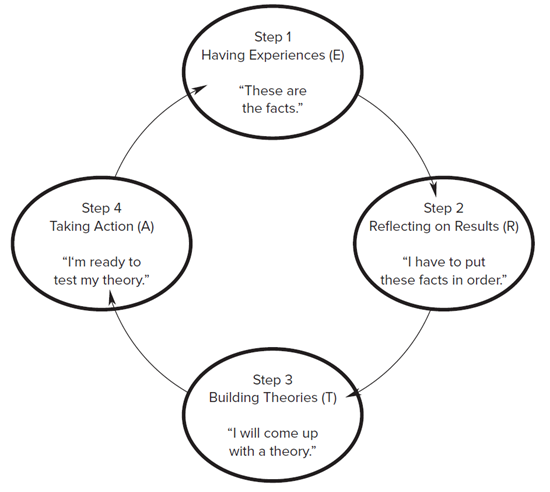
Problem solving: it has 4 elements such as E,R,T,A
•E: Having experiences
•R: Reflecting on results
•T: Building theories
•A: Taking action
For better understanding there is one problem solving cycle which will explain the whole part of the problem solving.
Virtual Teams
Operate across space, time, and organizational boundaries and are linked through information technologies
Work best with structured tasks requiring only moderate levels of task interdependence
Formation requires members who:
•Already know each other
•Are well connected to people outside the team
•Have volunteered to be part of the team
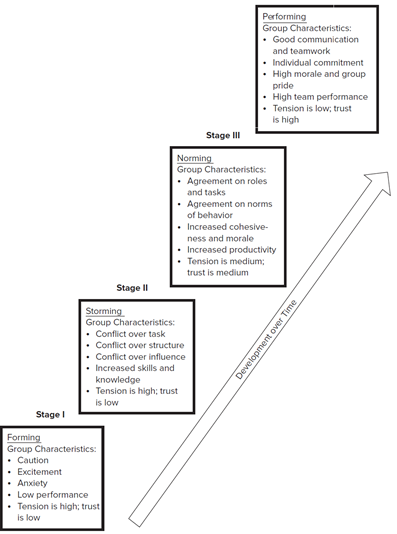
Stages in the Life of a Group :
There are 4 stages of a group all the stages have its group characteristics which explains the importance of each stages and where these stages stands.
hence at the end there are some group thinking symptoms which shows the groups image;
•Illusion of invulnerability
•Belief in the inherent morality of the group
•Rationalization
•Stereotypes of out-groups
•Self-censorship
•Direct pressure
•Mindguards
•Illusion of unanimity
some techniques to avoid the group think are
some techniques to avoid the group think are, Assigning the role of critical evaluator to each member ,Adopting an impartial stance to encourage open discussion and impartial probing of a wide range of policy and problem-solving alternatives, Setting up outside evaluators to work on the same policy question, Having one member play devil’s advocate when the agenda calls for evaluation of decision or policy alternatives, Holding a second-chance meeting to rethink the issue after reaching a preliminary consensus about what seems to be the best policy or decision.
Thank-you for reading my blog.
 Richa's blog