
In this blog i am going to tell you about the Employee Engagement, transformational power of human behavior, levels of emotional intelligence and how to manage conflicts and why people do what they do actually.
Firstly, we gonna start with, what business people think about this? According to business leader Lee Iacocca, effective leaders focus on three ‘p’s’
•People
•Products
•Profit
According to Mark McCormack, individuals with a finely tuned people sense, and an awareness of how to apply it, invariably take the edge. If something happens its because of some reason. so, therefore, Hierarchy of humans need are the major reason of human behavior.
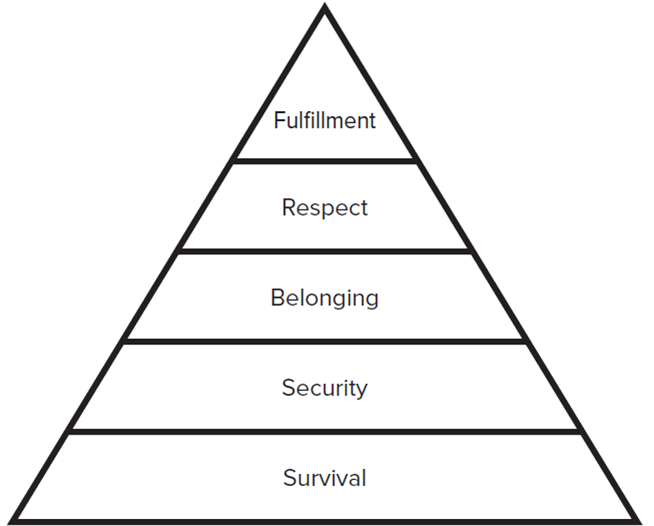
This image shows the five Hierarchy needs that is required by every human being.
Motivation at workplace: How leaders motivate their workers at workplace?
Effective leaders motivate people to accomplish tasks,
•Understand the needs of others
•Arrange conditions so that individual needs can be met
For most employees, a few words of appreciation create renewed energy and job commitment,
•Most employees leave their jobs because they do not feel they are recognized
•Most people believe they could give as much as 15 percent to 20 percent more effort at work than they now do with no one recognizing any difference.
Moving ahead to Employee Engagement, Employee engagement is the emotional commitment the employee has to the organization and its goals.
•Engagement involves both job satisfaction and organizational commitment
•Engaged employees show high levels of energy and persistence, striving as hard as they can to do good work
•Challenge that faces leaders is to tap the performance potential of all employees
•Negative attitudes and disruptive behavior of actively disengaged employees can be harmful to an organization
•Benefits of engagement are significant in improving organizational performance
Emotional Intelligence: It is the essential and indispensable requirement for effective leadership.
Two kinds of intelligence form the basis of emotional intelligence:
•Interpersonal intelligence: Ability to understand other people.
•Intrapersonal intelligence: Ability to form an accurate model of oneself and to be able to use that model to operate effectively in life.
Dimensions of emotional intelligence:
Self-awareness: Ability to recognize and understand the meaning of one’s own emotions, moods, and drives and their impact on other
Self-management: Ability to regulate one’s own emotions, keeping harmful impulses in check
Social awareness: Ability to understand another person’s emotions and know his or her needs, even though unstated
Relationship management: Ability to gain cooperation and inspire others, as well as to manage potentially dysfunctional emotions such as anger and fear.
Under the “Art of Persuasion” a successful leaders have to work with these three elements that is,
- Ethos: Argument by character
- Logos: Argument by logic
- Pathos: Argument by emotion
Next is the style of conflict, there are five style of conflict which is explain through graphical method for good understanding,
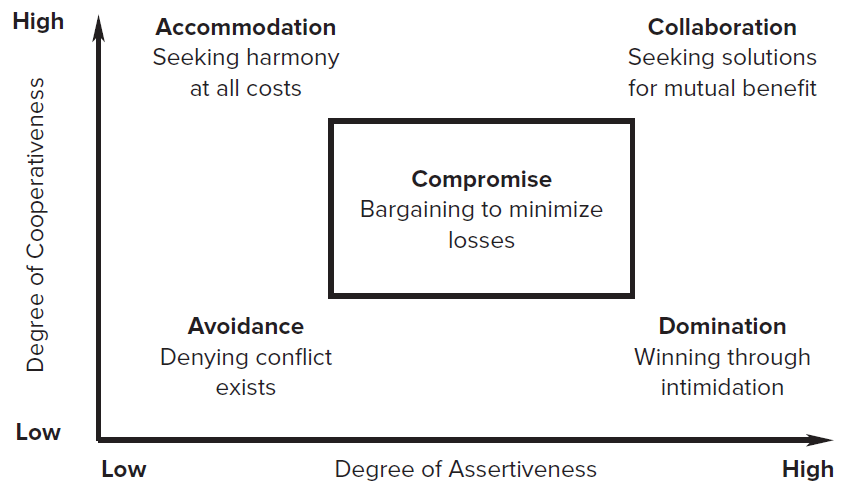
As avoiding conflict is very essential for leader to lead the team for the positive results and to avoid reduction in productivity. A successful leader choose the simple and easy way to deal with these conflicts so that his team member does not face any difficulty. A leader will deal with all the problems by Settling conflicts reasonably and fairly, considering everyone’s needs, Satisfying everyone’s needs reasonably and considering everyone’s wants fairly and moreover by Being ready to agree to disagree, invite third-party resolution, and walk separate paths.
Thank you for reading my blog. keep learning the good things and get motivated through it. stay connected with me for good knowledge.
 Richa's blog