
In this blog i will discuss different types of personalities and their characteristic. To learn about all the personalities we have to know about the theory of self concept.
Self concept-
Self-concept is the constellation of central ideas and attitudes a person has about herself or himself..
What people think and feel about themselves influences every aspect of life
Self-concept is singularly the most important determinant of the quality of a person’s life
People know their self-concept, dimly or clearly, and can usually justify why they do what they do in a word or phrase
People appear dedicated to become more of what they think they already are.
The Importance of Personalities-
Effective leaders understand their own personalities and the personalities of their subordinates
Different personalities have different needs and ways of behaving
Wise, caring, and effective leaders value the differences and strive to make the best use of the unique contributions of all types of people
Style of interpersonal relations is an important aspect of personality and an important element in dealing with people
Styles of Interpersonal Relations…
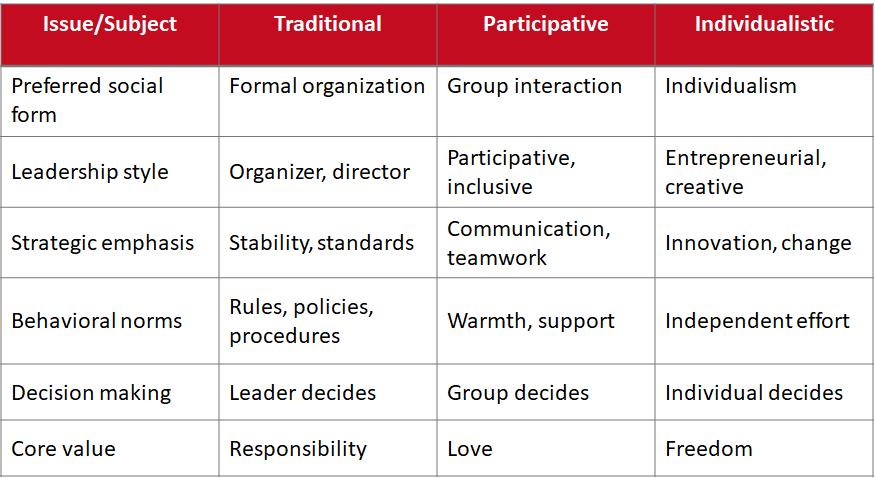
Traditional style: Exemplified by Moses, who is the foremost individual in Jewish history, and Queen Victoria, who is known for her moral strength and high standards of conduct
Participative style: Exemplified by Eleanor Roosevelt, who was people-caring and people-serving, and Benjamin Franklin
Individualistic style: Exemplified by Joan of Arc, who led the French people by her conviction and brave example, and Henry David Thoreau.
Personality and Culture:
People are products of their culture, which includes family, town, and country
Personality involves cross-cultural variations because it is a social construct
Traditional social orientations put the needs and interests of the group above the individual
Individualistic social orientations involve separating the self from others
Participative social orientations seek a middle ground between individualistic and traditional styles with an emphasis on warm and supportive human relations.
To deal with different types of personalities we need to have a good communication because differences in personality can result in perceptions and judgments that are poles apart.
Awareness of the nature and needs of different types of people is the first step in building relationships as it’s capable of leading to new levels of cooperation and success.
Improving Communication:
Talking it out
Talking in private so that all parties can communicate in an uncensored and honest way
Talking when people are fresh
Ensuring every word spoken passes three important tests, which analyze if it is it true, necessary, and kind
Being understanding
Seeing things from another person’s point of view
Trying to understand the forces in another person’s life that may have influenced and helped shape her or his personality
Being flexible
Being willing to compromise
Remembering that everyone must be flexible
Being tolerant
Recognizing that differences in personality are unavoidable
Recognizing that tolerance of different styles is necessary if communication, teamwork, and a one-team attitude are to be achieved.
The image below shows an overall description of each style of interpersonal relations ranging all 3 styles which will explain everything clearly.
Interpersonal Styles and Leadership Effectiveness…
Factors that are more important than interpersonal styles
Character
People will forgive a person anything when her or his character is good
Leadership
Effective leaders have a vision and a plan
Effective leaders keep job knowledge current to solve problems and advance the organization
Effective leaders demonstrate a humanistic approach in dealing with people
Diversity
Leaders should be tolerant of differences and value diversity as a strength.
Personality and Leadership…
- Meta-analysis of studies on personality and leadership supports certain generalizations
- People high in openness to experience tend to be broad-minded, creative, insightful, and curious
- People high in conscientiousness tend to be thorough, organized, self-disciplined, and dependable
- People high in extroversion tend to be active, outgoing, assertive, and sociable
- People high in agreeableness tend to be good-natured, courteous, approachable, considerate, and cooperative
- People high in neuroticism tend to be anxious, emotional, temperamental, and worrying.
- High conscientiousness, high agreeableness, and low neuroticism represent a common underlying characteristic called getting along
- People who have high extroversion and high openness to experience share a common underlying factor called getting ahead
- Extroversion is the factor most strongly associated with leadership effectiveness, whereas agreeableness is only weakly associated with it.
There is an interest personality test available online and you guys can give that test as its free and learn more about yourself and check you level. Name of the test is Big five personality test.
Thank you for visiting my blog. stay connected.
 Richa's blog